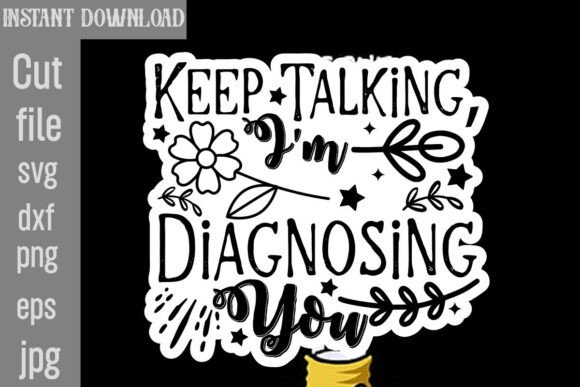
Keep Talking, I’m Diagnosing You SVG
Let’s be real: sarcasm sells—especially when it lands cleanly on a well-embroidered tote bag handed to a therapist friend at her baby shower. That’s exactly where Keep Talking, I’m Diagnosing You SVG landed for me last month. As someone who tests hundreds of embroidery files a year—across sweatshirts, baby onesies, aprons, and boutique patches—I approached this design not as a freebie download, but as a potential workhorse for my small shop’s holiday collection. And it held up.
A First Impression That Feels Intentional, Not Just Clever
The moment you open the file, you notice the rhythm: clean, centered lettering with subtle personality in the kerning and baseline. No over-the-top fonts or forced “sassy” embellishments—just confident, legible type with just enough weight to read clearly at 3–4 inches wide. It’s not shouting; it’s leaning in with a raised eyebrow. That tone translates beautifully to machine embroidery: no thin serifs to vanish in fill stitch, no fragile loops that’ll fray on a tea towel after three washes.
I immediately pictured it stitched on a heavyweight natural canvas tote—black thread on oat-colored fabric—paired with a minimalist embroidered stethoscope icon (added separately, of course). The design doesn’t need decoration to land. Its strength is restraint. That makes it unusually versatile for a sarcastic quote: it reads as witty, not juvenile; clever, not cringe.
Where It Shines—and Where It Needs a Second Look
Keep Talking, I’m Diagnosing You SVG works best when treated like a strong typographic embroidery file—not an applique design or dense monogram. I tested it across several real-world substrates:
- Sweatshirts & hoodies: Excellent clarity at 3.5" wide using medium-density fill stitch and tear-away + cutaway stabilizer combo. The letterforms hold shape without bleeding into fleece nap.
- Tote bags & kitchen towels: Clean stitching even on textured linen-cotton blends—no skipped stitches in the “g” descender or “y” tail, thanks to balanced stitch density.
- Baby onesies & burp cloths: Scaled down to 2.25", it stays legible with proper underlay and soft stabilizer. Avoid ultra-thin rib knits unless you’re using a lightweight topping.
- Patches & caps: Works on flat-backed twill patches with crisp satin-stitched edges. On curved cap fronts? Only if hooped precisely and stitched with reduced speed—those tight corners in the “d” and “g” need control.
Where caution is needed: dark fabrics with light thread (test contrast early), stretchy performance knits (use adhesive stabilizer), and anything with heavy texture like bouclé or corduroy (reduce density slightly and increase underlay). Also—don’t push it below 2" wide. The “I’m” contraction starts losing readability, especially in satin-stitch execution.
What It Does for Your Craft Business—Beyond the Stitch
This isn’t just another funny SVG. As an embroidery designer and Etsy seller, I judge designs by how they affect perceived value, customer trust, and repeat engagement. Keep Talking, I’m Diagnosing You SVG quietly elevates a handmade product because it feels curated—not generic. Buyers recognize intentionality. A therapist ordering a custom embroidered pillow cover with this phrase isn’t buying a joke; she’s buying recognition, identity, and craftsmanship in one tidy line.
That translates directly to your bottom line: higher perceived value means more room for premium pricing, better conversion on listings with clean mockups, and stronger brand consistency if you pair it with a cohesive set of sarcasm-themed embroidery files (like those in the broader Sarcastic Bundle). It also performs well in printable mockups—clean lines render crisply in PNG previews, helping your Etsy thumbnails stand out without visual noise.
Practical Designer Notes Before You Stitch
Before adding Keep Talking, I’m Diagnosing You SVG to your next batch of custom apparel or digital embroidery file listings, here’s what I do every time:
- Run a test stitch on scrap fabric matching your final substrate—especially if using textured or dark fabric.
- Check thread color contrast in both black-and-white and color mockups. Light gray thread on heather grey sweatshirts? Might disappear.
- Review stitch density: if your machine flags high density, reduce fill % by 5–8% rather than shrinking the design.
- Confirm hoop size compatibility—this design fits comfortably in a 4x4 hoop at standard scale, but verify before batching.
- Inspect small details: the apostrophe in “I’m” and the dot on the “i” should be fully formed, not collapsed into a single stitch.
- Use appropriate stabilizer: cutaway for knits, tear-away for stable wovens, and a light iron-on topping for napped fabrics.
- Double-check licensing: since it’s listed under Freebies and Graphics, confirm whether commercial use is permitted for finished embroidered products *and* for resale of digital embroidery files.
One final note: this design earns its keep not by being flashy, but by being reliable. It won’t wow with complexity—but it will deliver consistent, professional results across dozens of project types. That reliability is rare in the world of sarcastic SVGs, where too many sacrifice legibility for attitude. Keep Talking, I’m Diagnosing You SVG manages both.
Final Thought: A Design That Fits Real Life
Last week, I stitched it onto a navy denim apron for a local counseling center’s staff gift set. No frills. No extra icons. Just clean, confident embroidery—and a dozen therapists grinning while tying it on. That’s the quiet power of this file. It doesn’t ask to be noticed. It simply belongs—on sweatshirts, baby blankets, holiday gifts, boutique merchandise, and anywhere handmade sincerity meets dry humor. If you’re selecting embroidery files for real projects—not just scrolling through Freebies—you’ll appreciate how thoughtfully this one holds up, stitch after stitch.