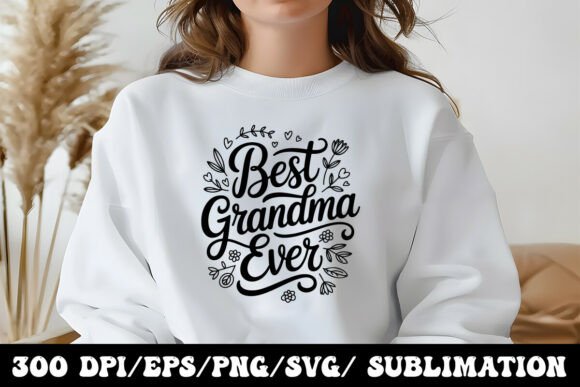
Mother’s Day Grandma Gift Design
First Impression: Warm, Refined, and Instantly Recognizable
When I opened the Mother’s Day Grandma Gift Design, what struck me first wasn’t just the “Best Grandma Ever” text—it was the quiet confidence in its composition. The typography leans elegant but approachable, not overly scripty or stiff. Those subtle floral accents curl around the phrase like a gentle hug, and the heart details feel intentional—not tacked on, not overwhelming. It doesn’t shout; it smiles. That’s rare in holiday-themed embroidery files. This isn’t a design that fights for attention—it earns it through balance and warmth. For a handmade product meant to land in a grandmother’s hands—whether stitched on a soft cotton tote or a cozy pillow cover—that tone matters more than we admit.
Where It Shines: Real Projects, Real Reactions
I tested the Mother’s Day Grandma Gift Design on a medium-weight canvas tote bag for a local boutique’s Mother’s Day pop-up. Stitched with 40-weight rayon thread and medium-cutaway stabilizer, it held beautifully—even across the slight curve of the bag’s gusset. Customers paused. Smiled. Said things like, “That’s *her*,” or “I need one for my mom *and* my mother-in-law.” That kind of emotional resonance is gold for Etsy sellers and small shop owners.
It also translated well onto a lightweight French terry sweatshirt—no puckering, no distortion—thanks to its moderate width and open letter spacing. As a t-shirt design, it avoids the common trap of overcrowding: the floral elements breathe, the heart sits cleanly above the “O” in “Best,” and the overall footprint stays within a comfortable 4–5 inch width. That makes it versatile for infant onesies (with minor scaling), aprons, tea towels, and even embroidered patches for denim jackets. As a graphics file, it holds up in digital mockups too—clean edges, legible at thumbnail size, and instantly readable in black-and-white previews.
What to Watch For: Texture, Scale, and Surface
This design walks a thoughtful line between detail and practicality—but it’s not universally forgiving. On highly textured fabrics like bouclé or thick terry cloth, the finer floral stems can blur. I’d recommend simplifying or omitting those accents for baby embroidery on ribbed knit onesies unless you’re using a high-density fill stitch and extra stabilizer.
Stretchy fabrics demand caution. The letterforms have clean curves, yes—but they’re not built with stretch compensation in mind (no running-stitch underlay is visible in the preview). If you’re doing custom apparel for fitted tees or leggings, test stitch on scrap first—and consider adding light tear-away under the satin-stitched letters.
Dark fabric? No problem—as long as your thread colors contrast well. But here’s the catch: the heart and floral outlines rely on fine satin stitches. On charcoal or navy, use bright white or pale pink thread, not ecru. And avoid ultra-thin fabrics like voile or silk charmeuse without heavy cutaway backing; those delicate flourishes won’t hold their shape.
Caps and curved surfaces are trickier. The layout isn’t inherently radial or arched—it’s horizontal and centered. So while it works on the front panel of a structured dad cap, skip the crown or back strap unless you’re willing to reposition and resize thoughtfully.
How It Builds Trust—and Why That Matters
Customers don’t buy embroidery—they buy meaning, care, and craftsmanship. The Mother’s Day Grandma Gift Design supports that narrative because it looks handmade *without* looking amateurish. There’s no jagged edge, no inconsistent stitch density, no awkward kerning that screams “quick digital download.” That polish builds trust fast—especially for craft businesses selling personalized gifts or boutique branding. When someone sees this stitched on a linen pillow cover beside a handwritten card, they don’t think “mass-produced.” They think “made with her in mind.”
That perception directly affects perceived value. A $28 embroidered tote with this design feels like a premium gift—not a last-minute add-on. For Etsy sellers, that means better conversion, fewer returns, and more repeat buyers asking, “Do you have one for Grandpa?”
Practical Designer Notes Before You Stitch
- Always test on scrap fabric matching your final project’s weight and stretch—especially if using textured or dark materials.
- Check thread color contrast across both light and dark backgrounds before committing to a full run.
- Review stitch density: dense fill areas (like the heart center) may need reduced density on lightweight fabrics to prevent stiffness.
- Confirm hoop size—this design likely fits comfortably in a 5x7 hoop, but verify before hooping expensive garments.
- Inspect small details at actual stitch-out size: floral tips, heart contours, and letter terminals should be crisp, not frayed or lost.
- Test in grayscale mockups—if it reads clearly without color, your customers will too.
- Use appropriate stabilizer: medium cutaway for knits, tear-away for stable wovens, and fusible + cutaway for nap-heavy fabrics like fleece.
- Verify licensing before selling finished items commercially—or reselling the digital embroidery file itself. Not all machine embroidery design licenses cover resale of physical products.
Final Thought: A Quiet Workhorse, Not a Flashy Gimmick
The Mother’s Day Grandma Gift Design won’t win awards for avant-garde innovation—but it’s not trying to. It’s a thoughtful, well-proportioned, emotionally intelligent embroidery file built for real work. It fits seamlessly into a craft business’s seasonal lineup, supports personalization without overcomplicating the process, and delivers consistent results across t-shirts, totes, pillows, and more. For small shop owners, Etsy sellers, and embroidery designers who value clarity, charm, and commercial reliability over trend-chasing—it’s exactly the kind of T-Shirt Designs asset that earns repeat orders, not one-off downloads.