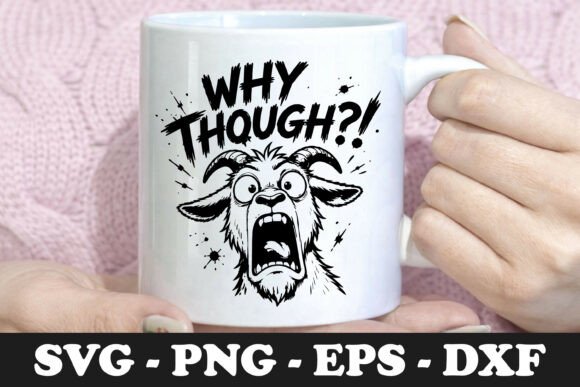
Shocked Screaming Goat Why Though Funny
A Designer’s First Glance: Playful Chaos, Not Just a Meme
When I opened the Shocked Screaming Goat Why Though Funny embroidery file set, my first thought wasn’t “cute” or “viral”—it was “this needs breathing room.” The illustration lands with bold, cartoonish energy: wide eyes, flared nostrils, exaggerated mouth, and that unmistakable “why though?!” expression. It’s not subtle—and it shouldn’t be. As an embroidery designer who’s stitched everything from nursery monograms to boutique sweatshirt logos, I immediately saw its strength: it’s built for recognition at a glance, not delicate realism. That makes it ideal for casual, personality-driven products—not formal branding or minimalist apparel.
Real Project Test: Embroidering It on a Linen Tote Bag
Last week, I prepped a custom order: a medium-weight natural linen tote for a local coffee shop’s staff gift. They wanted something lighthearted but not childish—something that said “we love our chaos” without undermining professionalism. I chose Shocked Screaming Goat Why Though Funny as the centerpiece, centered just below the top seam. Using a 4-inch hoop and medium-cutaway stabilizer, I ran a test stitch on scrap fabric first. The design held up well: clean outlines, no thread nesting in the goat’s open mouth or eyebrow arches, and enough negative space between features to avoid dense fill stitch buildup. On the finished tote, it read clearly—even from six feet away—and sparked genuine smiles during pickup. That’s the sign of a working design: it translates from screen to stitch to real-world reaction.
Where It Shines (and Where It Needs Caution)
Shocked Screaming Goat Why Though Funny excels in contexts where humor and instant readability matter most:
- Custom apparel: Works beautifully on crewneck sweatshirts, relaxed-fit tees, and denim jackets—especially when placed on the chest or upper back.
- Tote bag design & kitchen textiles: Stitches cleanly on cotton canvas, tea towels, and aprons. The bold lines hold up through repeated washing if proper stabilizer and quality thread are used.
- Embroidered patch & cap projects: With minor digitizing tweaks (like simplifying inner mouth detail), it adapts well to twill patches or curved front panels—just confirm your hoop size fits the full width before stitching.
- Holiday embroidery & personalized gifts: A standout on baby onesies (use soft tear-away stabilizer), pillow covers for teen rooms, or quirky Christmas stockings.
But here’s where attention matters:
- Small hoop sizes (under 3 inches): The goat’s expressive face loses impact if scaled too small—you’ll sacrifice clarity in the eyes and mouth. Stick to 3.5" minimum for legibility.
- Textured or stretchy fabric: Avoid heavy terry cloth or thin jersey unless you add extra stabilizer and reduce stitch density manually. The design’s sharp angles can pucker on unstable surfaces.
- Dark fabric: The original files don’t include reversed or white-underlay versions—but you *can* add a white fill layer beneath key features (like the whites of the eyes) for contrast. Always test this in your embroidery software first.
- Dense stitch areas: The goat’s fur texture (if included in the fill) can create thick, stiff zones on lightweight items like baby caps. Simplify or convert to satin stitch outlines only for softer drape.
What It Adds to Your Craft Business—Beyond the Laugh
For Etsy sellers and small shop owners, Shocked Screaming Goat Why Though Funny isn’t just another funny graphic—it’s a conversation starter with commercial legs. When customers see it stitched cleanly on a handmade product, it signals confidence in execution: they trust you’ve chosen a design that *works*, not just one that looks good on screen. That builds credibility faster than any description. It also pairs well with complementary digital embroidery files—think coordinating “Why Though?” text banners or minimalist goat silhouettes—to create cohesive bundles. And because it falls under Illustrations and Graphics, it integrates smoothly into printable mockups for listings, social previews, and wholesale pitch decks.
Practical Designer Notes Before You Stitch
Before using Shocked Screaming Goat Why Though Funny in your next embroidery project:
- Test on scrap fabric first—especially if pairing with textured or dark materials.
- Review stitch density in your embroidery software; reduce fill stitch % by 5–10% on lightweight fabrics to prevent stiffness.
- Check thread color contrast early—bright yellow or electric blue pops on navy, but pale mint may disappear on light gray.
- Confirm hoop size compatibility; the design’s width should leave at least 0.5" margin inside your hoop’s inner edge.
- Inspect small details like eyelashes or nostril lines—they’re charming on screen but may vanish when stitched at small scale.
- Try black-and-white mockups to assess silhouette strength and visual balance without color distraction.
- Use proper stabilizer: cutaway for knits, tear-away for stable wovens, and fusible + tear-away for sheer or delicate layers.
- Verify licensing before selling finished embroidered items or reselling the digital embroidery file—this is a digital download, so commercial use terms depend on the seller’s policy.
Final Thought: A Design That Earns Its Smile
Not every funny illustration survives the jump from screen to stitch—but Shocked Screaming Goat Why Though Funny does. It’s got rhythm in its lines, intention in its exaggeration, and flexibility across common craft business applications. Whether you’re stitching it for a client’s custom apparel line, bundling it as part of your digital embroidery file shop, or adding it to your next batch of holiday embroidered patches, it delivers personality without sacrificing practicality. Just remember: great embroidery isn’t about how many files you get (PNG, SVG, EPS, DXF—all helpful), but how thoughtfully you use them. This one earns its place in your working library—not as filler, but as a reliable, joyful tool.