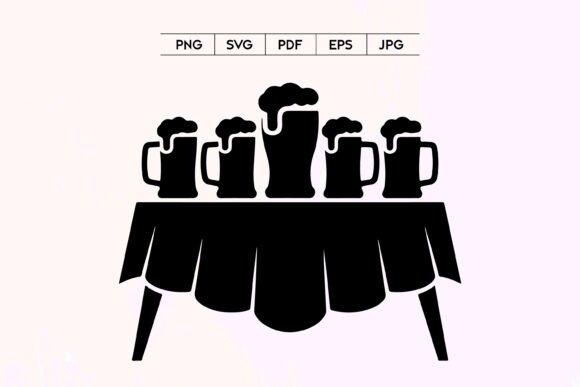
Beer Mug Party Table
A Designer’s First Look: Festive, Friendly, and Ready for Stitching
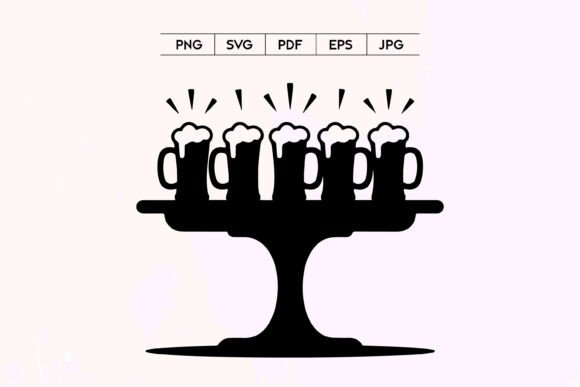
Opening Beer Mug Party Table feels like walking into a well-lit pub on a Friday evening—warm, inviting, and full of quiet energy. The composition centers on a cheerful, slightly stylized beer mug with generous foam, tilted just enough to suggest motion and celebration. It’s not hyper-realistic, but it’s detailed enough to read clearly at 3–4 inches tall: subtle highlights in the foam, clean mug contours, and a compact, balanced layout that avoids visual clutter. As an illustration, it leans into friendly accessibility—not fine art, not clipart—and that’s exactly what makes it strong for embroidery.
Where This Design Truly Shines (and Where It Might Hesitate)
I recently tested Beer Mug Party Table as the focal point on a custom embroidered canvas tote for a local brewery’s staff gift program. We stitched it at 3.75" wide on midweight cotton duck, using tear-away stabilizer and standard 40-weight polyester thread. The result? Crisp, legible, and instantly recognizable—customers smiled before they even read the tagline. That tells me this design excels in custom apparel, tote bag design, aprons, and tea towels. Its clean lines translate well to satin stitch outlines and smooth fill-stitch foam, and the moderate detail level holds up without excessive stitch density.
It also works beautifully on sweatshirt embroidery—especially when placed high on the chest or across the back—as long as you avoid ultra-thick fleece blends that swallow fine detail. I’ve seen it hold up nicely on baby onesies too, though only when sized down to 2.5" and paired with lightweight cut-away stabilizer. For embroidered patch applications, it’s ideal for 3–4" merrowed or heat-seal backing, especially when used for bar crawl swag or brewery merch.
Real-World Considerations Before You Hoop It Up
That said, Beer Mug Party Table isn’t magic—it responds honestly to fabric and technique. On stretchy fabric like jersey tees, the mug’s curved rim and foam texture can blur if stabilizer is under-applied. On dark fabric, test your thread colors early: light tan or cream foam may disappear without a white underlay or contrasting outline. And on curved surfaces like caps, keep placement above the bill curve—its horizontal emphasis doesn’t adapt as gracefully to severe dome distortion as a centered round motif would.
For small hoop sizes (under 4x4"), resize thoughtfully: drop below 2.25", and the foam’s texture starts to flatten; tiny highlights risk merging or disappearing entirely. Likewise, avoid dense decorative accents like heavy puff or chenille unless you’re willing to digitize enhancements yourself—the original file set is clean vector and raster, not pre-digitized embroidery files. So if you’re sourcing this as a digital embroidery file, confirm whether it includes .PES, .DST, or other machine-ready formats—or plan to digitize from the included SVG/EPS.
What It Adds (and Doesn’t Add) to Your Finished Product
Beer Mug Party Table elevates a handmade product by signaling intention and craft—not just “beer-themed,” but *celebration-themed*. That nuance matters. A customer buying a personalized gift for their friend’s homebrew birthday isn’t just getting a mug graphic—they’re getting warmth, camaraderie, and lighthearted professionalism. That lifts perceived value, supports brand consistency for small shops, and increases buyer engagement on Etsy listings where visual clarity and mood drive clicks.
But it won’t carry weak execution. Poorly hooped stitching, mismatched thread contrast, or rushed stabilizer choices will expose its simplicity—not as a flaw, but as honesty. This isn’t a design that masks technical shortcuts. It rewards attention to stitch density, thread color harmony, and fabric prep. When done right, it reads as confident and handmade; when rushed, it reads as generic.
Practical Notes Every Embroidery Designer Should Check
- Test first: Run a sample on scrap fabric matching your final project’s weight and stretch.
- Review stitch density: If digitizing yourself, ensure foam areas aren’t overfilled—moderate density keeps texture readable after washing.
- Confirm hoop size: Measure your intended placement against your machine’s max hoop dimensions—don’t assume 4x4" is enough.
- Inspect small details: Zoom in on the foam’s edge and mug handle in your embroidery software—do they scale cleanly?
- Try black-and-white mockups: Does the design retain shape and impact without color cues?
- Compare light/dark backgrounds: How does it read on navy denim vs. natural linen?
- Use proper stabilizer: Cut-away for knits, tear-away for stable wovens, fusible for lightweight tea towels.
- Check licensing: Since this is listed as Illustrations and Graphics, verify commercial use rights before selling finished items or bundling as design assets.
Final Thought: A Reliable, Human-Centered Asset
Beer Mug Party Table won’t win awards for avant-garde illustration—but it wasn’t built to. It was built for the craft business owner stitching 20 brewery totes before Saturday’s farmers’ market, the Etsy seller updating holiday embroidery bundles, or the small shop product designer refreshing kitchen towel collections. It’s dependable, scalable, and emotionally resonant without being cloying. In a landscape full of overdesigned or underdeveloped graphics, it lands squarely where it should: useful, joyful, and ready for real work.