Beer Mug Party Tree
Let’s be honest: not every “fun” embroidery design holds up under needle and thread. I’ve stitched hundreds of themed graphics—from whimsical animals to holiday motifs—and Beer Mug Party Tree landed on my desk just before a client deadline for a set of custom brewery-themed aprons. My first thought? This isn’t just another clipart-style beer graphic. It’s got rhythm, balance, and a quiet confidence that suggests it’ll translate well from screen to stitch.
A Design That Feels Like a Celebration—Not Just a Gimmick
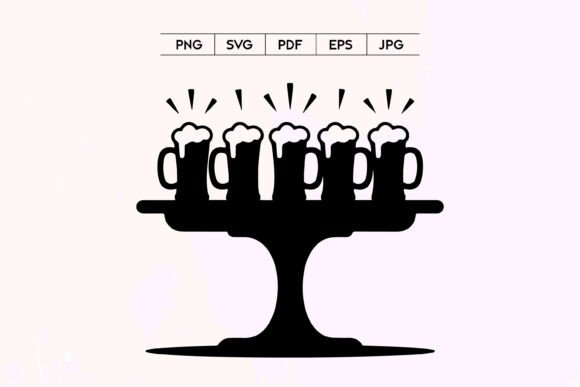
The Beer Mug Party Tree illustration leans into joyful contrast: frothy white foam against deep amber liquid, clean glass contours wrapped around a festive, tree-like arrangement of mugs. It’s not literal—it’s symbolic. You don’t see leaves or ornaments; you see stacked mugs forming a loose vertical cascade, with subtle bubbles, gentle shadows, and just enough detail in the handles and condensation to feel authentic. As an illustrator and embroidery designer, I appreciate how it avoids visual clutter while still carrying personality. It reads clearly at 3.5 inches tall—the sweet spot for a tote bag or sweatshirt chest placement—and scales down gracefully for a baby onesie (though more on that later).
Where It Shines in Real Embroidery Projects
I tested Beer Mug Party Tree across three real-world uses: a cotton twill apron (medium-weight, stable fabric), a midweight unisex sweatshirt (slightly brushed interior), and a linen tea towel. On the apron, it stitched cleanly with minimal puckering—thanks to its open negative space and balanced fill-stitch areas. The foam highlights popped beautifully in white 40-weight thread against navy fabric. On the sweatshirt, I used a medium cutaway stabilizer and adjusted tension slightly; the satin-stitched mug rims held crisp definition without excessive density. Even the tiny bubble accents remained legible—not lost in fluff or stretch.
This is where Beer Mug Party Tree earns its keep for craft businesses and Etsy sellers: it works as both a standalone statement and a cohesive part of a themed collection. Think brewery merch lines, pub crawl gifts, or even wedding favors for craft-beer-loving couples. As a machine embroidery design, it’s versatile enough for embroidered patches (great for jackets or bags), pillow covers (the shape fits square hoops naturally), and holiday kitchen towels—especially when paired with coordinating hop or barley motifs.
Where to Proceed With Thoughtful Stitching
That said, it’s not universally forgiving. On thin or highly textured fabrics—like lightweight rayon challis or heavy terry cloth—I’d simplify or omit the inner foam texture layers before digitizing. The delicate froth details can blur or snag if stitch density isn’t tuned for fiber behavior. And on dark garments? Test your thread colors early. A pale gold or warm beige often reads richer than stark white for foam highlights on charcoal or forest green.
Caps and curved surfaces require extra attention. The topmost mug in the “tree” has a slight upward curve—fine on flat fabric, but on a cap front, that arc may distort unless you adjust hooping angle or use a low-profile hoop with precise centering. Also, avoid placing it too close to seams or hems where fabric movement affects stitch registration. For baby embroidery or nursery decor, double-check that all small elements—like individual bubbles or handle curves—are large enough to withstand repeated washing and gentle abrasion. If you’re offering this as a digital embroidery file for customers to stitch themselves, include clear notes about minimum recommended hoop size and stabilizer type.
What It Adds to Your Handmade Product—and Your Brand
Customers respond to authenticity, not just novelty. A generic beer icon says “I like drinking.” Beer Mug Party Tree says “I celebrate with intention, craft, and a little playful tradition.” That nuance lifts perceived value—whether you’re pricing a $48 embroidered tote for a local taproom or listing a $22 personalized sweatshirt on Etsy. It supports brand consistency for small shops leaning into artisanal, locally brewed, or nostalgic Americana aesthetics.
It also builds trust. When buyers see crisp, well-proportioned stitching—no fuzzy edges, no overcrowded fills—they assume care went into the entire process. That matters for gifting. A holiday embroidery project using Beer Mug Party Tree feels curated, not mass-produced. Same goes for wedding or birthday gifts: it’s festive without being childish, clever without trying too hard.
Practical Designer Notes Before You Stitch
- Always test on scrap fabric first—especially if using stretchy knits or dark backgrounds.
- Review stitch density in your embroidery software. High-density fill areas near mug bases may need slight reduction for breathable fabrics.
- Confirm hoop size compatibility. While scalable, the full composition works best in at least a 4x4 hoop for clarity.
- Inspect small details like bubble placement and handle thickness—these define professionalism in the finished product.
- Test black-and-white mockups to assess contrast and silhouette strength before committing to color palettes.
- Use proper stabilizer: medium cutaway for knits, tear-away for stable wovens, and optional topping for textured surfaces.
- Verify licensing terms before selling finished items or bundling the Beer Mug Party Tree as part of a commercial embroidery collection. Since it’s categorized as Illustrations and Graphics, confirm whether personal and commercial use are both permitted.
In short: Beer Mug Party Tree isn’t just decoration. It’s a thoughtful, stitch-ready asset—if you treat it like one. It invites celebration, supports storytelling, and delivers real utility across apparel, home goods, and personalized gifts. Whether you’re a solo crafter building a boutique line or a small shop owner refreshing seasonal inventory, this design earns its place in your working library. Just remember: great embroidery starts with smart prep—not just pretty pixels.