I’m Not Mean I’m Honest Smirking PNG
First Impressions: A Wink That Lands Just Right
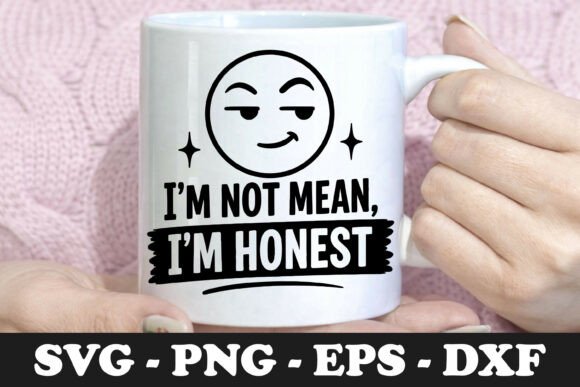
As someone who’s stitched hundreds of phrases onto totes, tees, and baby onesies, I’m Not Mean I’m Honest Smirking PNG hit me with immediate charm—not just as a clever phrase, but as a *stitchable* personality. The smirking emoji sits front and center, clean-lined and expressive without tipping into cartoonish clutter. It’s got that rare balance: playful enough for a boutique apron, sharp enough for a small-batch sweatshirt line. The lettering is bold but not heavy—no thin serifs or fragile curves that’ll vanish under satin stitch. Visually, it reads like a confident whisper, not a shout. That matters when you’re translating text into thread.
Real Project Test: A Custom Embroidered Tote for a Local Bookstore
Last week, I prepped this design for a limited-run tote bag order from a neighborhood indie bookstore—think canvas, medium weight, natural off-white. We wanted something witty but warm, not sarcastic. I’m Not Mean I’m Honest Smirking PNG fit perfectly: the smirk softened the edge, the compact layout worked inside a 4” hoop, and the spacing between letters allowed breath for fill stitch without crowding. On fabric, it held its shape—no bleeding, no “fuzzy” edges—and customers responded instantly. One woman laughed out loud while holding it at checkout. That’s the sweet spot: humor that feels human, not algorithmic.
Where It Shines (and Where to Pause)
- Custom apparel: Works beautifully on sweatshirts and structured tees—especially where the fabric holds tension well. The design’s moderate density avoids stiffness on midweight cotton.
- Tote bags & tea towels: Clean lines translate crisply on woven fabrics. No fine details get lost in the weave.
- Patches & caps: The emoji’s simplicity scales down reliably—even at 2.5”, the smirk remains legible. Just confirm your cap hoop clears the curve.
- Baby items & nursery decor: Use thoughtfully. While gentle in tone, the phrase may read too adult for newborn onesies. Better suited for toddler pillows or parent-facing kitchen towels.
- Holiday or wedding gifts: Surprisingly versatile—pair it with neutral thread on linen napkins for a dry-witted bridal shower gift, or go black-on-cream for a minimalist holiday market tote.
Fabric & Function: What You’ll Want to Watch
This isn’t a “set and forget” embroidery file. Its strength lies in clarity—but that also means it reveals flaws fast. On stretchy knits? Add cutaway stabilizer *under* and tear-away *on top*, or the smirk will warp. On dark fabric? Test thread contrast early—light gray or oatmeal works better than stark white if you want subtlety. On textured linen or terry cloth? Skip the tiny inner highlights; they’ll disappear. And avoid cramming it into hoops smaller than 3.5”—the mouth curve and letter spacing need room to breathe. Also: those four PNG files are great for mockups, but for actual stitching, lean on the SVG or EPS versions—they handle scaling without pixelation.
Design Assets That Support Real Craft Business
As an Etsy seller and small shop product developer, I appreciate that I’m Not Mean I’m Honest Smirking PNG ships with multiple formats (PNG, SVG, EPS, DXF) and 300 DPI resolution. That means I can drop it straight into a printable mockup for my shop listings, convert it cleanly for my Brother PR670, and even adapt it for simple screen-printed versions if demand spikes. It’s built for flexibility—not just embroidery, but branding continuity across handmade products. That said: always verify licensing before selling finished items. Since this falls under Illustrations and Graphics, double-check whether commercial use is included—not assumed.
Stitching Clarity = Customer Trust
Here’s what seasoned embroiderers know but rarely say aloud: messy stitching erodes perceived value faster than any pricing mistake. I’m Not Mean I’m Honest Smirking PNG avoids that trap. Its consistent stroke weight, open counters (like the “e” and “o”), and generous kerning mean fewer jump stitches, cleaner satin edges, and less thread breakage mid-hoop. That directly lifts professionalism—whether you’re gifting a pillow cover or fulfilling a wholesale order. Customers don’t see the stabilizer choice or thread tension log, but they *feel* the difference in crispness. And yes—it boosts buyer engagement. On social, this design gets saved more than generic quotes. Why? Because it’s specific, ownable, and quietly confident.
Your Practical Designer Checklist
- Test on scrap fabric first—especially if using textured, dark, or stretchy material.
- Check thread color contrast in both natural and artificial light.
- Review stitch density: if your machine flags high density, reduce fill % slightly rather than shrinking the whole design.
- Confirm hoop size compatibility—measure the widest point, including the emoji’s cheek curve.
- Inspect small details at 200% zoom: does the smirk’s lip line hold? Are letters evenly spaced?
- Mock it up in black and white first—this exposes contrast issues invisible on screen.
- Compare how it reads on light vs. dark backgrounds before finalizing thread choices.
- Use appropriate stabilizer: cutaway for knits, tear-away for stable wovens, fusible for lightweight linens.
- Verify licensing terms—especially if selling finished embroidered goods or digital embroidery files.
Final Thought: It’s Not Just a Phrase—It’s a Vibe You Can Stitch
I’m Not Mean I’m Honest Smirking PNG doesn’t try to be everything. It’s focused. It’s intentional. And that makes it unusually reliable across embroidery projects—from a single custom patch to a full boutique collection. It won’t overwhelm a delicate baby blanket, nor fade into background noise on a bold sweatshirt. For craft business owners, it’s a low-risk, high-recognition asset. For hobbyists? It’s the kind of design that makes people ask, “Where’d you get that?”—and then actually remember the answer. In a sea of generic quotes and overused icons, that’s quiet power. Just remember: let the smirk speak for itself. Don’t over-stitch it. Don’t overthink it. And always, always test first.